
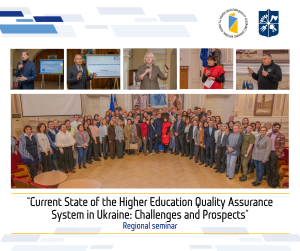
On November 6, 2025, NAQA held a final regional seminar in Kyiv as part of the series “Current State of the Higher Education Quality Assurance System in Ukraine: Challenges and Prospects” at the National Technical University of Ukraine “Igor Sikorsky Kyiv Polytechnic Institute”.
The seminar programme covered key areas for improving the higher education quality system: development of internal quality assurance systems, post-accreditation monitoring of study programmes, application of the “List of Major Drawbacks”, features of developing study programmes for regulated professions, and advice to universities on cross-border quality assurance. These topics were presented by NAQA Head Andrii Butenko and Vice Heads Olena Yeremenko, Bohdan Morklianyk, Ivan Nazarov, and Nataliia Stukalo. Special attention was paid to practical work: as part of the regional seminar, Igor Sikorsky Kyiv Polytechnic Institute held a workshop entitled “Experience of Accreditation of Study Programmes by Foreign Agencies”, during which participants learned about the tools and procedures of European quality assurance agencies and discussed practical steps for interacting with them based on university experience.
Despite the announced air raid alert, the event began without delay – part of the programme was organised in a shelter, which allowed participants to start working in safe conditions.
This regional seminar was the last in the series “Current State of the Higher Education Quality Assurance System in Ukraine: Challenges and Prospects”, which NAQA implemented during 2024-2025. A total of 15 seminars were held in 13 cities of Ukraine – Kyiv, Kropyvnytskyi, Sumy, Kharkiv, Cherkasy, Zaporizhzhia, Dnipro, Odesa, Vinnytsia, Chernivtsi, Uzhhorod, Lviv, and Ostroh – bringing together over 1,800 participants. This series provided an opportunity to create a space for professional discussions and exchange of experience, as well as to support universities in adapting to updated approaches to quality assurance in higher education.